The Dealer Lab: Podcast on dealer disruption, automotive influence, and the future of fixed ops
In Episode 26 of The Dealer Lab podcast, host Max Materne welcomes Brendan Baker, editor-in-chief of Powersports Business, for a wide-ranging, unfiltered conversation, tracing Baker’s unconventional path through the industry and unpacking the forces reshaping powersports retail.
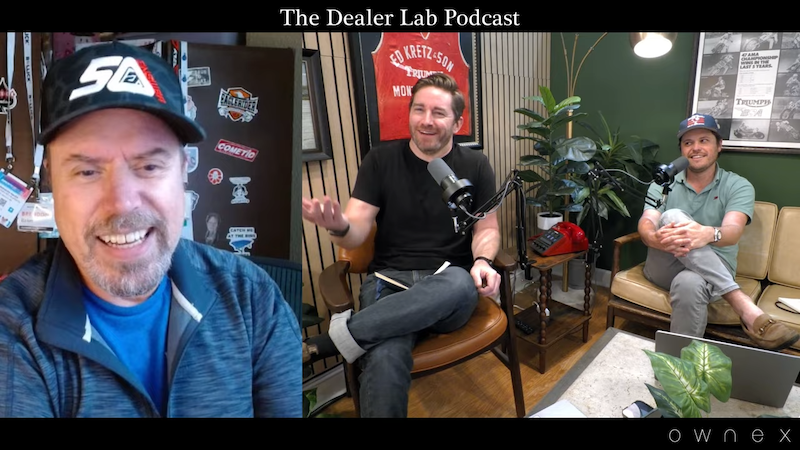
From his early days in Akron, Ohio, racing quarter-midgets in the 1970s, to working in automotive parts and professional racing, Baker’s career ultimately led him into trade journalism roles across automotive and powersports before taking the helm at Powersports Business. As he describes it, “a mechanic’s brain who happens to be an editor.”
That technical, hands-on background frames a discussion that quickly moves beyond biography and into the structural shifts facing powersports retail.
Changing retail landscape
Baker and Materne dig into the current wave of dealership closures, challenging assumptions about which operators are most at risk. Baker notes that vulnerability is not always tied to poor performance, but often to scale and leverage.
“The first ones to close are not always the worst operators,” Baker says. “Sometimes they are the best ones, leveraged to the hilt to look the part.”
The conversation also explores the growing influence of automotive retail groups entering powersports, including Sonic Powersports. Baker points to Sonic’s reported 1,100-unit weekend during Sturgis as a signal of accelerating process-driven retail adoption in the space.
“Sonic is not even scratching the surface,” he says. “They sold 1,100 motorcycles at Sturgis and they think there is room to do more this year.”

Platforms such as One Dealer Lane are also discussed as part of a broader effort to compress the sales process, in some cases down to as little as 20 minutes — fundamentally changing expectations on the retail floor.
Fixed ops and talent
While sales efficiency continues to improve, Baker and Materne agree that the deeper challenge lies in fixed operations.
The service department, Baker argues, remains the most underdeveloped and strategically critical part of the dealership experience. Talent shortages, wage compression, and high turnover among service advisors create instability that directly impacts customer retention.
“On the powersports side, you can be a master tech and still make a fraction of what an automotive guy makes,” Baker says. “That is the sad part.”
He emphasizes that service advisors often represent the most important customer relationship in the dealership, and when they leave, that trust leaves with them.
AI, efficiency, and humans
The conversation closes on the role of artificial intelligence in dealership operations. Rather than replacing human interaction, Baker frames AI as a tool to eliminate administrative burden and restore time for customer-facing relationships.
“AI will help lift the boats of the humans involved,” he adds. “It is not about replacing trust; it is about giving people their time back to build it.”
Macro tailwinds
Despite industry disruption, Baker highlights the continued strength of the broader outdoor recreation economy, estimated at $1.3 trillion, with powersports occupying a significant share. The challenge, he argues, is not demand — it is adaptation.
“The macro tailwind is still there,” he says. “The dealers who modernize the experience are the ones who will catch it.”
Listen to Episode 26
The full conversation with Brendan Baker is available across major podcast platforms:
- YouTube: https://youtu.be/sjQ-TpCY1aQ?si=iH_Uk00U6bIeAzzV
- Spotify: https://open.spotify.com/episode/1okdw8skF1wASqeVY2TMMb?si=RSR7NRJVQFu3N7-azJjBDQ
- Apple Podcasts: https://podcasts.apple.com/us/podcast/26-brendan-baker-powersports-business-editor-in-chief/id1853642926?i=1000766099106
- Amazon Music: https://music.amazon.com/podcasts/ab341258-629c-411e-a38f-7b01f5636577/episodes/a180e234-01b2-4908-8905-868ed8724805/26-brendan-baker-powersports-business-editor-in-chief