Cleveland Moto’s 25-year blueprint for surviving a shifting market
This article originally appeared in the December issue of Powersports Business.
We sat down recently with Phil Waters, owner of Cleveland Moto and longtime voice of the Cleveland Moto podcast, for a Power Hour interview. Waters — whose shop has been a staple in Northeast Ohio for more than 25 years — shares insights on the shifting two-wheel market, the role of premium scooter sales, the value of vintage service, and why he added Moto Morini to his lineup.
Built for two wheels
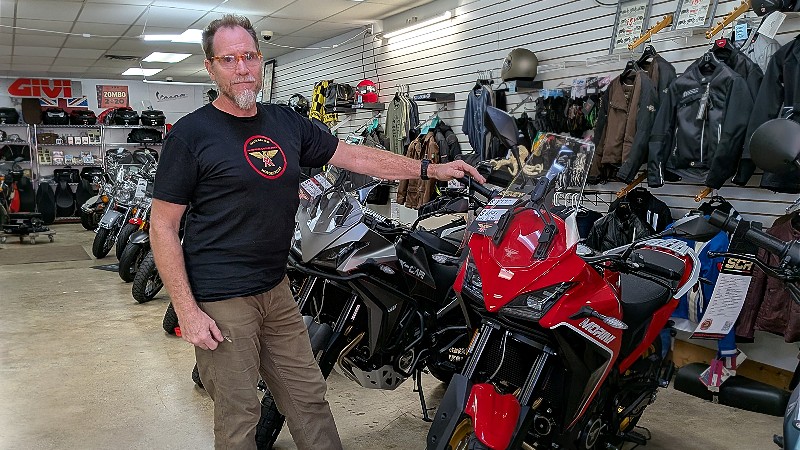
Cleveland Moto’s identity has always been crystal clear: two wheels only. “We don’t do ATVs or side-by-sides,” Waters says. “People ask if we can work on a Can-Am, and I tell them it doesn’t fit through the door. We’ve only got two-wheel doors.”
The business started in downtown Cleveland as a Vespa-focused operation before moving to Lakewood, where customers felt a scooter store belonged. Eventually, Waters settled the dealership in Cleveland’s historic West Park neighborhood — an area with a long motorcycle lineage thanks to generations of firefighters and police who lived there under the city’s former residency requirements.
The area remains dense with two-wheel activity. “There are about four shops within a tight radius,” Waters says. “And then you’ve got Santa’s Motorcycle Supply and Sills Motor Sales, both nearly 70 years old. Sills was one of the first Honda dealerships in the area. Cleveland’s got deep motorcycle roots.”
Scooters strong, entry-level down
Asked about current sales trends, Waters echoes what many dealers have seen in 2024–25.
“The premium brands — Vespa especially — are still moving,” he says. “Vespa is a destination brand for a lot of people. Those customers are still buying.”




The slowdown is happening everywhere below premium, according to Waters.
“The $3,000 to $4,000 working-class scooters? Those aren’t selling. The super low-end Chinese scooters — other shops do a lot of that — aren’t selling either,” he says. “Lower-income and middle-income buyers are feeling the pinch. Everyone’s freezing. Even if they could finance something, they’re still holding back.”
But there are still seasonal surprises.
“Every year we panic in mid-September and think we’re done. And then the old white guys save fourth quarter,” Waters jokes. “Autumn is their superpower. They love riding this time of year. We’ll get guys who literally waited all year to buy a Moto Morini until the leaves changed.”
Vintage work keeps shop going in winter
One key to Cleveland Moto’s longevity is its commitment to vintage service — a rarity among modern dealerships.
“We’re a year-round shop. We don’t lay anybody off,” Waters says. “Winter is when we work on the vintage bikes. There’s enough old iron in Cleveland to keep us busy.”
But there are limits.
“If you bring us a 1971 Moto Guzzi in March, we’re not touching it. Months that end in ‘-ber’—that’s when the vintage bikes come in,” he says. “March, April and May are for selling and prepping modern inventory. The vintage stuff keeps the lights on in January.”
A podcast that became an institution
Cleveland Moto’s podcast, now more than 525 episodes deep, started almost by accident. Waters and his friend Dustin were wrenching on a CB750 in a garage when a comedian friend walked in and said, “You guys are hilarious. Somebody should be recording this.”
Dustin, a musician and sound engineer, grabbed a recorder. The rest is history.
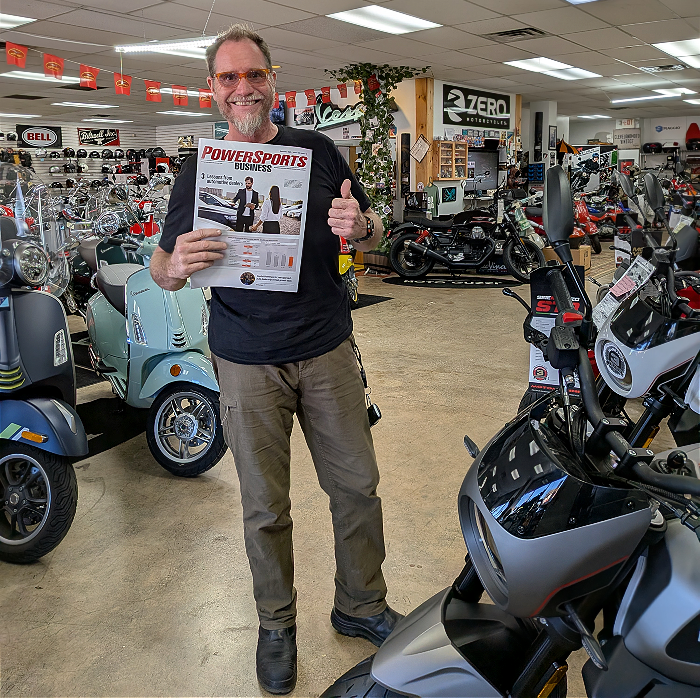
They experimented with a professional studio but eventually moved back to the garage. “We sounded great in the studio, but we lost the fun. No beer, no smoking,” Waters says. “The garage had soul.”
The show has developed a devoted community, including a Patreon base that helps fund equipment upgrades. “One listener came in for an episode, went home, and mailed us five Shure mics because he said we could sound better,” Waters laughs.
Today, the show streams live video with real-time switching thanks to producer “Sleepy,” a video professional with Summit Racing. “He’s amazing. Great editor, great drone pilot. He brings the whole thing together.”
Adding Moto Morini
A major shift in direction for the shop came with the addition of Moto Morini — an Italian brand with far deeper roots than the average American rider realizes.
“Moto Morini started in 1937,” Waters says. “People think it’s just a name a Chinese company bought, but Morini has a big racing history. They helped fund the development of Ducati’s early motors. There’s a lot of cross-pollination in the Italian motorcycle world.”
Morini’s modern revival is backed by Chinese manufacturer Zongshen, but the brand retains its design center and leadership in Milan, Italy.
“That matters,” Waters says. “When you design in Milan, you get the benefit of Italian component partners — Brembo, Marzocchi, Pirelli. You see that when you look at the bikes.”
The Seiemmezzo and X-Cape models — mid-displacement adventure and naked bikes — have impressed customers.
“They don’t cheap out. Pirelli Scorpions come standard. Good forks. Good brakes. These are quality bikes on par with Thai-built Japanese models, maybe better,” he says. “And the three-year unlimited-mile warranty? Customers love that.”
Waters signed with the brand at AIMExpo last year after comparing them with other emerging models.
“Right now, the meme is, ‘Oh look, another affordable Chinese motorcycle.’ But that’s exactly what people said about Japanese bikes in the 1960s,” he adds. “This is déjà vu. And these bikes are legitimately good.”
Why mid-size bikes are the future
Waters sees a huge opportunity in the 450–700cc class — especially as traditional heavyweight-cruiser buyers age out.
“The market is shifting down,” he says. “That mid-category is the pocket for new riders, returning riders, and older riders who don’t want 1200cc anymore.”
Adventure models in particular are hitting the sweet spot.
“You look at Moto Morini and others bringing 450s and 500s. That’s where things are going,” he says. “Americans used to scoff at a 500 — ‘It’s only a 500’ —but that narrative is breaking.”
He also sees broader global trends influencing what Americans will ride next.
“Seven of 10 vehicles in India and Asia are two-wheelers. Here it’s one out of fifty,” he says. “They build for the world. We’re just one market now.”
Knowing your lane
Asked why Cleveland Moto thrives while others fade, Waters circles back to identity and community.
“We know who we are: we’re a two-wheel shop that sells Vespas, sells cool motorcycles, works on vintage, and has a good time doing it,” he says. “Cleveland has a strong motorcycle culture, and we’re proud to be part of it.”