
Harley-Davidson raises 2026 guidance as ‘Back to the Bricks’ gains traction
Harley-Davidson executives struck an optimistic tone during the company’s second-quarter earnings call July 23, saying the early stages of its “Back to the Bricks” turnaround strategy are delivering measurable gains in dealer profitability, retail sales and inventory health, prompting the company to raise its full-year guidance.
The upbeat outlook came despite lower consolidated earnings, ongoing tariff uncertainty and continued softness in Europe. Management said disciplined inventory management, stronger-than-expected North American retail performance and positive early reception for the new Superglide and Deadwood models gave the company confidence to improve its outlook for both Harley-Davidson Motor Co. (HDMC) and Harley-Davidson Financial Services (HDFS).
“We are still early in the work, but the business is moving in the right direction,” CEO Artie Starrs told analysts during the earnings call.
The comments followed Harley-Davidson’s second-quarter earnings release, which showed consolidated revenue declined 6% year over year, largely reflecting the transformation of HDFS into a less capital-intensive business model. At the Motor Company level, however, revenue increased 6% to $1.1 billion and operating income improved to $72 million from $61 million in the prior-year quarter.
Dealer profitability takes center stage
More than any financial metric, executives repeatedly highlighted improving dealer profitability as evidence the company’s turnaround strategy is working.
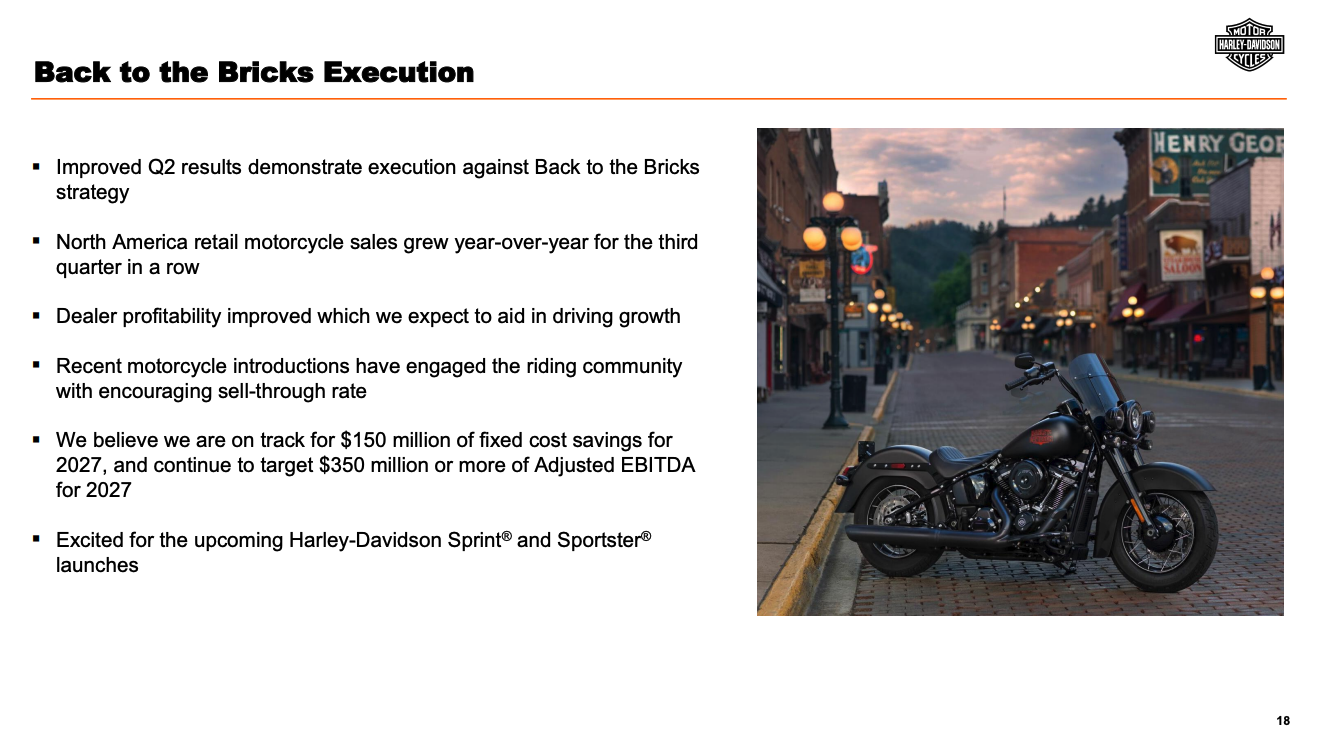
Since unveiling its “Back to the Bricks” strategy in April, Harley has emphasized reducing excess inventory, aligning wholesale shipments with retail demand and restoring healthier margins throughout its dealer network. Those efforts appear to be paying off.
“Based on current trends, we expect domestic dealer profitability to double in 2026,” Starrs said. “Dealer health was a central theme in our Q4 and Q1 discussions, and I want to be very clear that it remains non-negotiable.”


Dealer inventory declined 17% globally compared with a year ago, including a 15% reduction in North America. More importantly, executives noted that 85% of dealer inventory now consists of current-model-year 2026 motorcycles, compared with less than 75% a year ago.
The healthier inventory mix has significantly changed conversations with dealers, Starrs said.
“If I think about the conversations… in the fourth quarter, nearly every dealer was telling me they had too much inventory,” he said during the analyst question-and-answer session. “Today, the vast majority believe it’s either just right or they’re asking for more bikes.”
Chief Financial and Commercial Officer Jonathan Root added that Harley has no plans to flood the channel with inventory despite improved demand.
“We feel pretty good about where inventory is in total,” Root said. “Don’t expect that you’re going to see an increase in dealer inventory in any significance over the coming quarters.”
Instead, Harley plans to focus on getting “the right bike in the right place at the right time” as additional models are introduced.
New models energize dealers
The company’s confidence also stems from the market reception to its newest motorcycles. Harley recently introduced the Superglide and Deadwood as part of its strategy to broaden its lineup with more affordable, customizable “blank canvas” motorcycles.
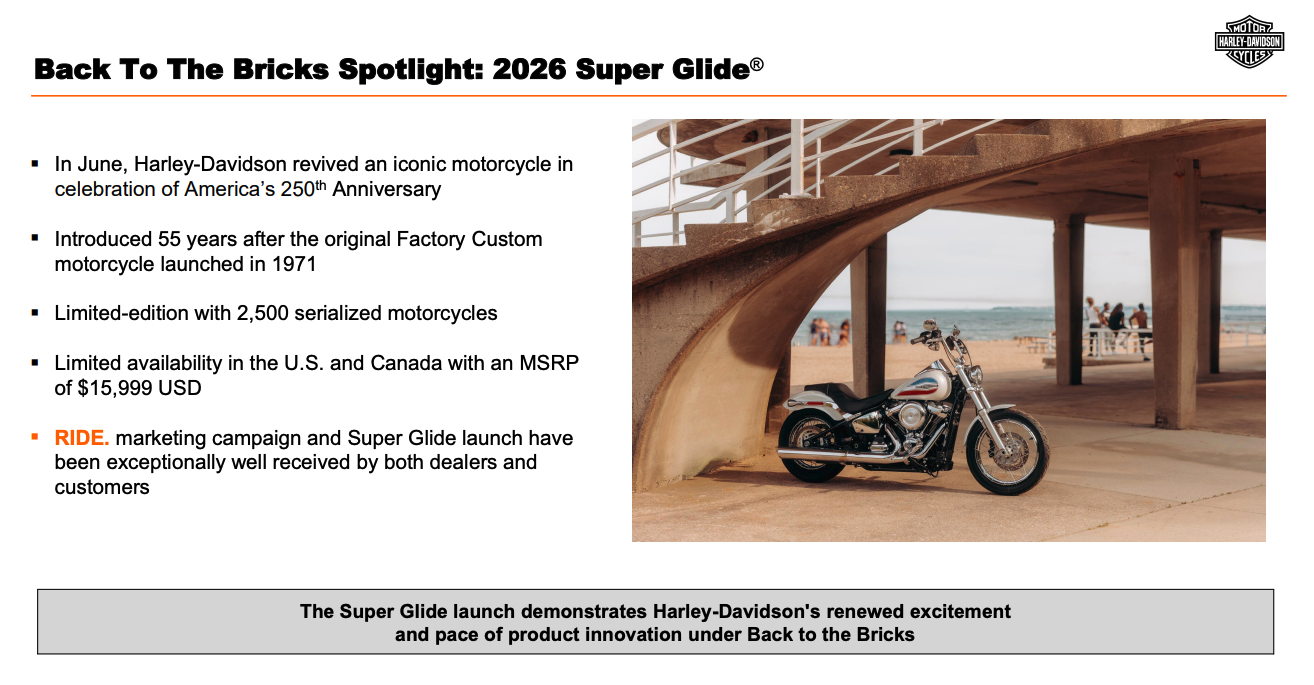
According to Starrs, both launches have exceeded expectations.
“Sell-through on Superglide has been strong, dealer enthusiasm has been high, and MSRP realization is among the strongest we have seen in some time,” he said.
The Deadwood, which recently began arriving in U.S. dealerships, has generated positive reactions from both consumers and motorcycle media, Starrs added, citing its vintage styling, customization potential and accessible price point within the Softail family.
Executives also pointed to continued strength from the Nightster and redesigned Trike models, saying more accessible motorcycles are helping Harley reach customers beyond its traditional long-distance touring audience. The renewed focus on customization extends beyond motorcycles. Starrs said Harley has appointed a new general manager for its Parts & Accessories business and is seeing early signs of improvement.
“Customization is not an add-on to the Harley-Davidson experience; it is core to the Harley-Davidson experience,” he said.
North America offsets European weakness
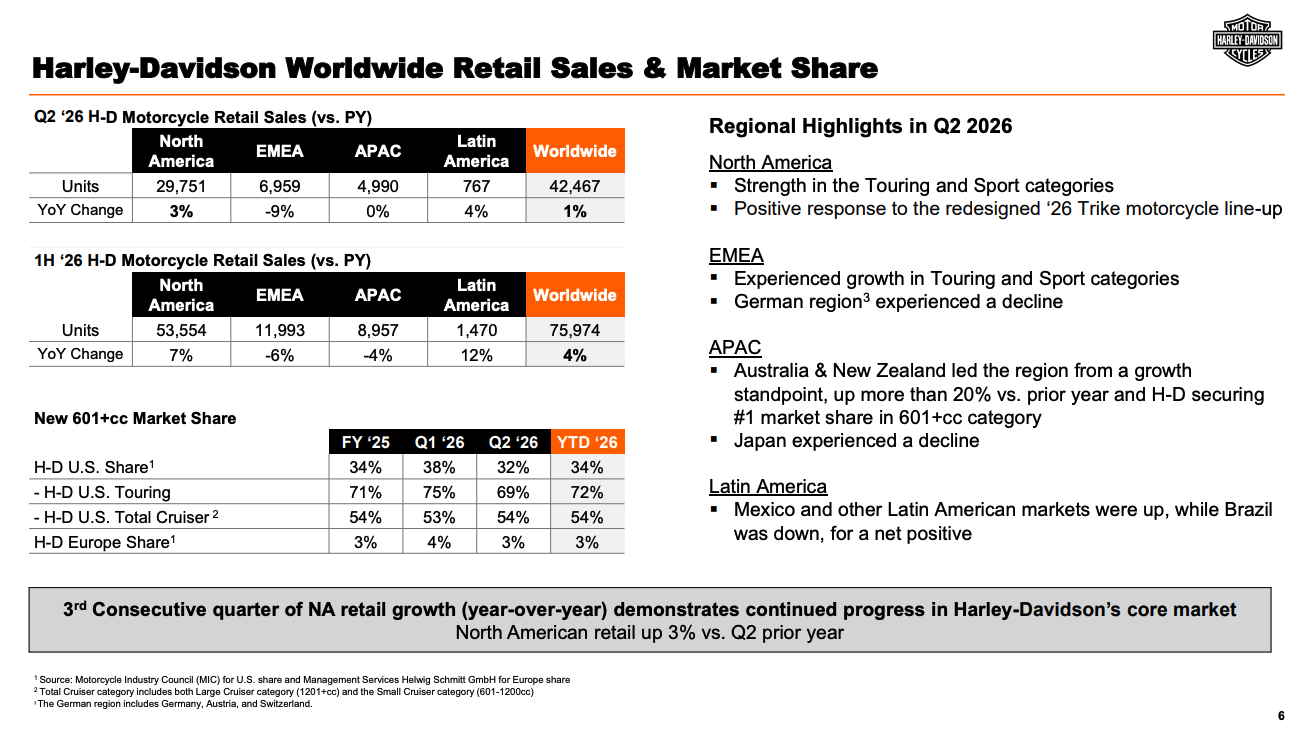
North America remained Harley’s strongest region during the quarter. Retail sales increased 3% in North America, following a 14% gain in the first quarter, giving Harley its third consecutive quarter of year-over-year retail growth in the region. The company also maintained a 32% share of the U.S. market for motorcycles above 601cc.
Starrs credited stronger product offerings, targeted marketing and a more disciplined promotional strategy.
“The second quarter was more consistent with a normalized promotional environment,” he said. “The fact that we’re able to grow in that environment has us pleased.”
Outside North America, however, challenges remain. Retail sales declined 9% in Europe, where Harley cited a weaker economic environment and continued pressure on consumer spending. Executives acknowledged the region remains an area requiring improvement and said product changes are already underway, including the planned return of the Sportster 883 in 2027.
Latin America continued to outperform with retail sales up 4%, while Asia-Pacific posted modest growth led by Australia and New Zealand.
Guidance raised
Reflecting stronger retail trends and improved execution, Harley increased its full-year outlook. The company now expects retail and wholesale shipments of 133,500 to 138,500 motorcycles, up from its previous guidance of 130,000 to 135,000 units.
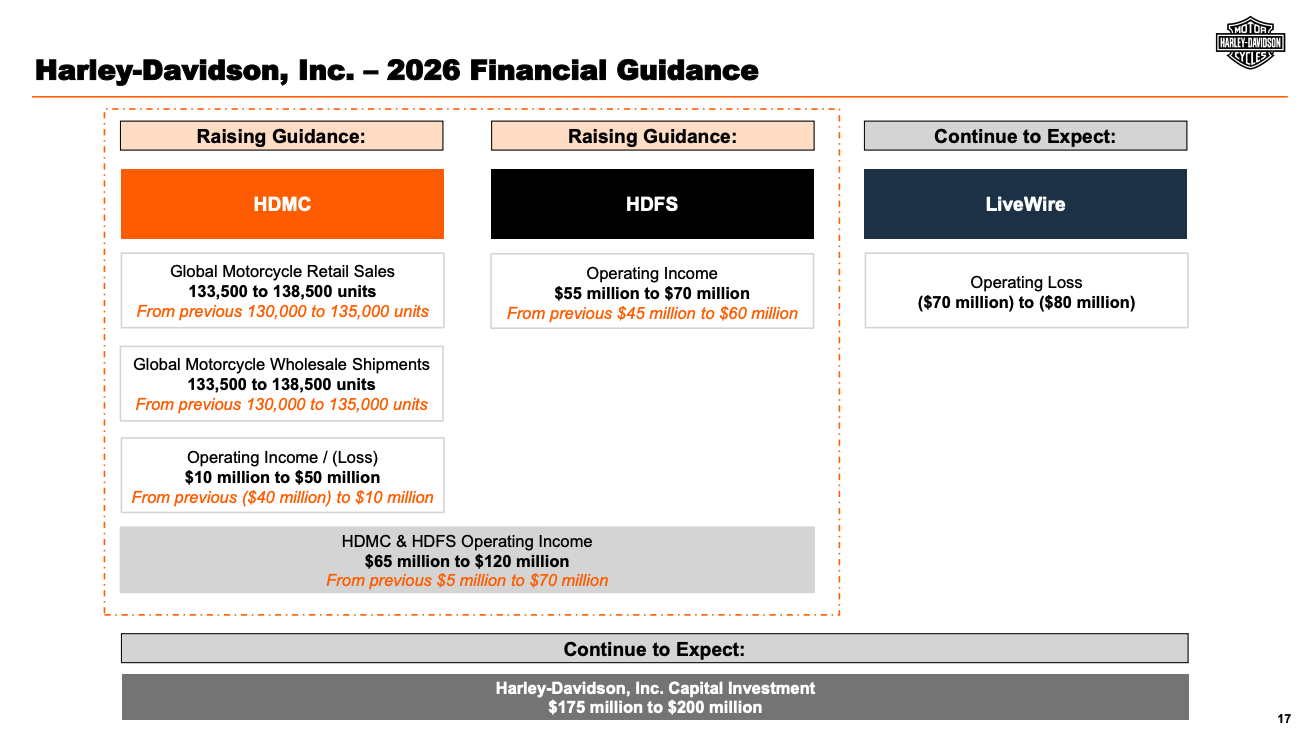
Harley also raised HDMC operating income guidance to a range of $10 million to $50 million, compared with its previous outlook of a $40 million loss to a $10 million profit. HDFS operating income guidance also increased to $55 million to $70 million.
Executives said retail and wholesale shipments should remain closely aligned through the remainder of 2026, reflecting the company’s continued emphasis on inventory discipline.
Tariffs remain a wildcard
While management expressed confidence in its outlook, executives acknowledged tariffs remain one of the largest external risks facing the company. Harley continues to expect tariff costs of $75 million to $90 million this year, unchanged from previous guidance.
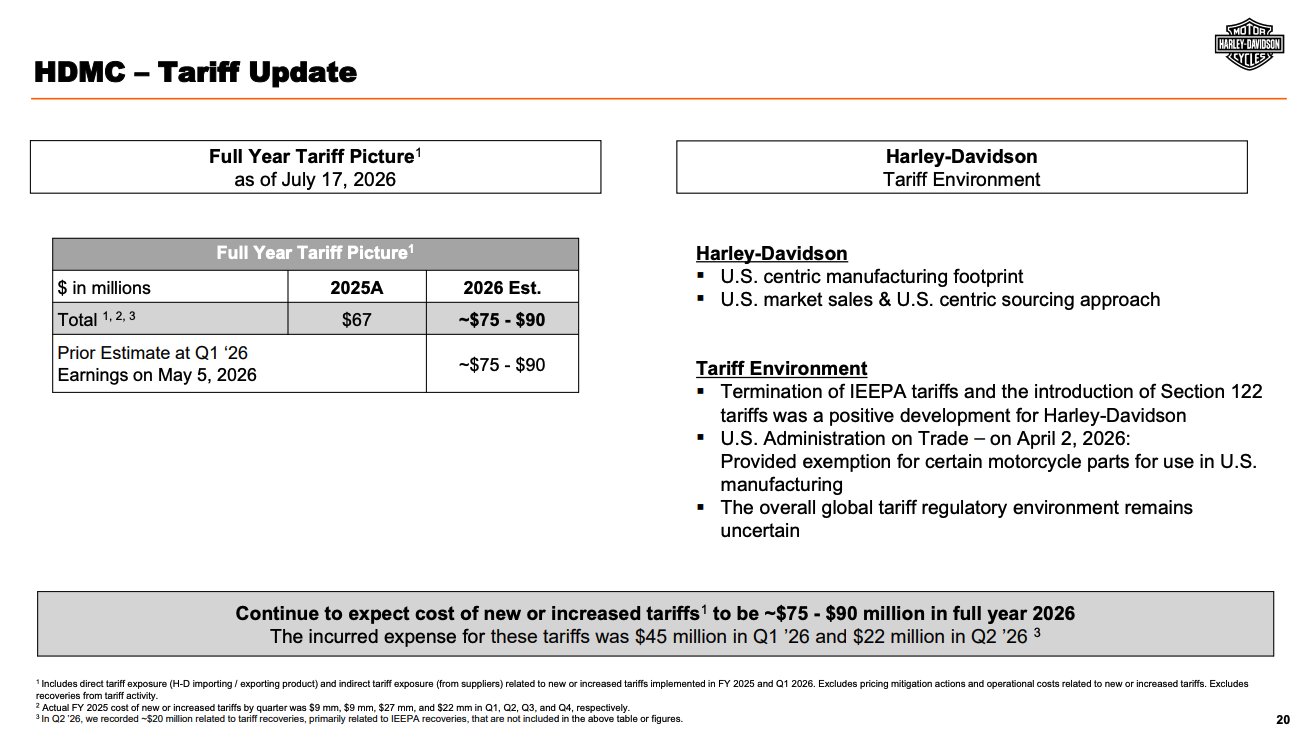
The company benefited from approximately $20 million in tariff recoveries during the second quarter but said it is not assuming additional recoveries during the remainder of the year.
Starrs also highlighted Harley’s decision to move production of Rev Max engines for North American motorcycles back to the United States, a move intended to reduce future tariff exposure while reinforcing domestic manufacturing.
Investors remain cautious
Although Harley’s raised guidance represents an encouraging sign for the company’s turnaround, investor concerns have not disappeared. Earlier this month, S&P Global Ratings downgraded Harley-Davidson’s credit rating to below investment grade, citing concerns about the company’s long-term profitability and execution of its “Back to the Bricks” strategy.
Analysts on the earnings call repeatedly questioned management about inventory discipline, tariff assumptions and whether recent performance justified raising longer-term financial targets. Starrs declined to revise Harley’s 2027 objectives but said the company remains on pace to deliver $150 million in fixed-cost savings and exceed $350 million in HDMC EBITDA by next year.
“We feel quite good about the 150,” Starrs said. “Either on track or slightly ahead.”
Dealer outlook
For Harley dealers, the second quarter suggests the company’s strategy is beginning to translate into healthier showroom economics. Inventory levels have normalized, MSRP realization remains strong, used motorcycle values continue to improve, and executives say dealers are once again asking for additional inventory instead of working to reduce it.
“I think there was a saying at one point in time that we want to make one less bike than there might be demand for,” Starrs said. “I think on an aggregate basis, we’re in that general vicinity.”
As Harley heads into the second half of the year—and prepares to showcase its newest motorcycles during the upcoming Sturgis Motorcycle Rally—the company believes those fundamentals position both the factory and its dealer network for a stronger finish to 2026, even as broader economic and trade uncertainties persist.
This is the first glimmer of hope in years. This is a classic business school case of forgetting who you are. It was apparent to any outsider that the previous management team was bilking the company, employees and shareholders for years. I for one really hope this new team can keep moving forward and that the company will recover and thrive.