
AI in the dealership: Trust, but verify
As powersports dealerships increasingly turn to artificial intelligence for marketing, customer communications, data analysis and other day-to-day tasks, new research suggests that getting value from AI requires more than simply adopting the latest tools.
A new report from SAS, based on research conducted with IDC, found that organizations with stronger AI governance, data quality, oversight and accountability practices were significantly more likely to report strong returns on their AI investments.
While the study did not include powersports dealerships specifically — its 2,699 respondents represented banking, insurance, life sciences and the public sector across 28 countries — its findings offer some practical lessons for dealers using AI.
Perhaps the most notable finding:
97.2% of AI users surveyed said they override AI-generated recommendations at least some of the time. —SAS
The leading reason employees override AI isn’t necessarily because they know the recommendation is wrong. It’s because they don’t understand how the system arrived at its decision.
For dealers, that points to a simple rule for AI adoption: trust the technology, but verify its work.




AI can help dealership employees write marketing copy, respond to customer inquiries, summarize leads, analyze sales information and perform other repetitive tasks. But employees should still have the ability — and responsibility — to review AI-generated information before it influences a customer or business decision.
Build a strong data foundation
The report also highlights an issue that should be familiar to dealership operators: AI is only as good as the information it receives. SAS found that only 17.5% of enterprises have a fully optimized data infrastructure considered mature enough for the demands of increasingly autonomous, or “agentic,” AI. Organizations with optimized data foundations were four times more likely to expect strong ROI from AI projects.
For dealerships, that reinforces the importance of maintaining accurate customer, inventory, sales and service data. An AI system working from outdated inventory information or incomplete customer records can produce confident-sounding answers that are still wrong.
Keep humans in the loop
The research also found that trust declines as AI becomes more autonomous, falling from 76% for generative AI to 66% for agentic AI.
That distinction could become increasingly important for dealerships. There is a significant difference between asking an AI tool to draft an email and allowing an AI system to independently communicate with customers, make recommendations, or execute actions.
Dealers should establish clear boundaries for what AI can do on its own and what requires employee approval. That could mean reviewing AI-generated customer communications before they are sent, requiring employee approval for pricing or sales recommendations, and assigning responsibility for monitoring AI-driven processes.
Measure the payoff
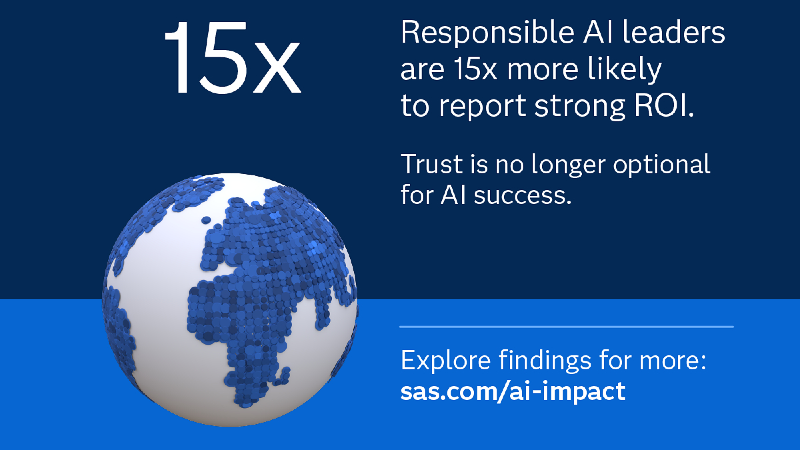
The business case for these safeguards is significant. SAS reported that organizations investing in trustworthy AI practices were 15 times more likely to report strong or high ROI from their AI projects — 62% compared with 4%.
The study also found that organizations with the strongest trustworthy-AI practices reported 1.85 times greater gains across 13 business outcomes, including revenue growth, cost savings and customer experience.
For dealers, the takeaway isn’t necessarily to slow down AI adoption. Instead, it is about being more deliberate in how AI is deployed.
Before giving an AI system greater responsibility, dealerships should know what data it uses, establish who is accountable for its output, determine when human approval is required, and track whether the technology is actually improving productivity, customer experience, or profitability.
AI may eventually handle increasingly complex dealership tasks. But the research suggests that the dealers most likely to benefit will be those that build trust and accountability into their AI strategy from the beginning.